
“I wake up one morning drowning in the routine. I put down my guitar and leave Athens, and my happiness blew me at dawn to the south, which has beautiful girls and always summer. Heraklion, Kalamata and sweet cherry…” sings Miltiadis Paschalidis in his song Iraklio-Kalamata.
The best olives in the world
It is a bit strange that this singer chooses these two cities in this song. Because Heraklion and Kalamata are not exactly the first cities that come to mind when we think about idyllic places in Greece. Heraklion is best known as the city where planes with holidaymakers land. The arriving visitors of this city usually travel on as quickly as possible, spreading across the island of Crete.
And Kalamata? Yes, Kalamata… This city is best known for its olives. According to many, these are the best olives in the world. The large almond-shaped Kalamon olives – with their typical dark purple color and smoky flavor – are also my favorite. In my opinion, the taste far exceeds other varieties such as the small black Niçoise, the light green Spanish Manzanilla and the bright green Sicilian Nocellara. By the way, only the Kalamon olives that come from Kalamata and the surrounding area may be called ‘Kalamata olive’. The product has received a PDO (Protected Designation of Origin).
From Athens to Kalamata
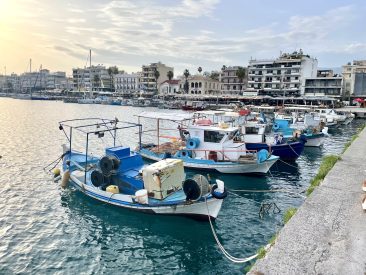
But what else does Kalamata actually have to offer? We decide to explore the city. To start with a few simple facts: Kalamata is the capital of the Messinia region, the westernmost part of the Peloponnese. The city is located directly on the sea, has an industrial port, an airport, a university and approximately 70,000 inhabitants. Since the construction of the last parts of the great Athens-Kalamata highway a few years ago, you can drive from the Greek capital to Kalamata in about two hours. The bus connection between both cities therefor is also excellent.
The golden hour
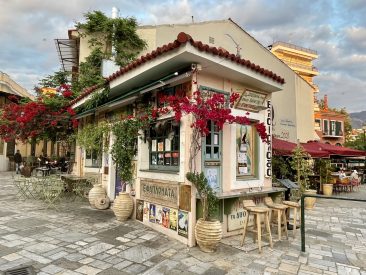
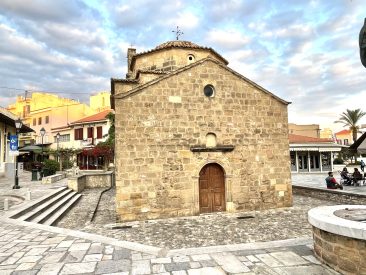
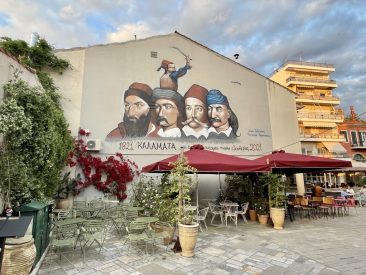
Our first hour in the city is a success. In the old town, the tavern at 23 Martiou square proves to be a hit. Meanwhile, the sun is almost setting, and the ‘golden hour’ illuminates the tall buildings and therefor we have a beautiful view of the Aghio Apostoli, the Holy Apostle Church. This Byzantine church was built in the 11th/12th century and still contains a few centuries-old icons. Around the corner, a graffiti work decorates a large concrete wall. On the occasion of the 200th anniversary of independence in 2021, an artist was commissioned by the municipality to create portraits of four important freedom fighters. Our meal consists of a few specialties of this city: fried sfela cheese, spinach with black-eyed beans, cod with tomato and raisins. Of course also a salad with Kalamata olives. And of course a bottle of wine from a local winery.
The next morning we return to this place to further explore the old town. And once again we are lucky. It is Wednesday and the weekly market is held in he large market hall. More than four hundred producers and traders from the city and surrounding area offer their goods here – on Wednesdays and Saturdays. Fruit, vegetables, meat, fish, olive oil, wine, clothing, flowers and plants form a colorful whole. We discover special herbs, buy a large bag of Greek mountain tea and taste a delicious alcoholic drink made from artichoke.
Kala matia, beautiful eyes
Kalamata was largely destroyed in the struggle for independence against the Ottomans in 1825. Several earthquakes also caused a lot of damage in the city. During of one these, the major earthquake in 1987, dozens of residents were killed and many buildings were damaged beyond repair. Therefor this city is fairly new, largely laid out according to a grid-shaped street pattern that was in vogue in the nineteenth century. Fortunately, some things have been preserved in the old center and the narrow streets are teeming with taverns, bars and small shops.
The Kastro, built in the 13th century, also withstood the earthquakes reasonably well. The castle, which often provided protection to the local population over the centuries, can still be visited.
At the foot of the remains of this fortress lies the Ypapanti Cathedral. Unfortunately, the church has been destroyed so often by wars and earthquakes that this basilica is quite new, built in the nineteenth century. Although the building is impressively large, it does not have the charm of the many Byzantine churches that we still encounter here and there.
The church is also responsible for the naming of the city. One of the icons in this cathedral showed Mary with beautiful black eyes. Kalá mátia, which means ‘beautiful eyes’, was gradually corrupted into Kalamata.
Silk production
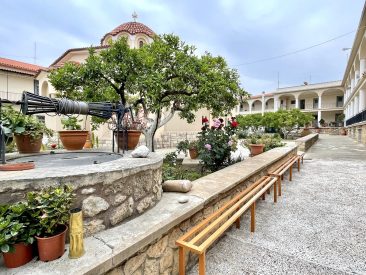
Not far from the large basilica is a nunnery, the Kalograion. At the time of our visit, the gate is open and we walk into the courtyard. On either side we see arcades with corridors. This is probably where the nuns’ rooms are located, judging by the simple wooden chair that stands in front of the door of each room. There is total peace in the courtyard at the time of our visit. The nuns probably take a siesta at this time of day.
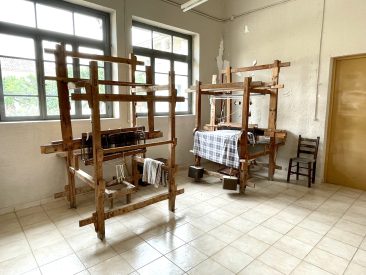
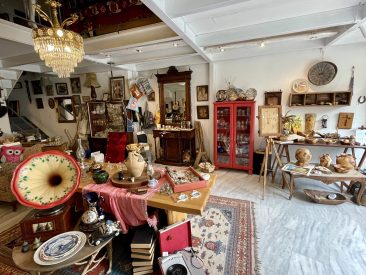
We had hoped to be able to admire the silk scarves here, and perhaps also buy one of these products. The city of Kalamata has traditionally been a center of silk production and it appears that they are still made in this monastery. But unfortunately, not a nun or a scarf in sight. And then a door on the ground floor appears to be open and we see a loom. We slip inside and suddenly find ourselves in the nuns’ workshop. Dozens of looms, with chairs in front of them, are set up in three connected rooms with high ceilings. The walls are covered with icons and crucifixes. There are antique cupboards with crockery and vases everywhere. As if we have stepped straight into the Middle Ages.
After this secret visit to the studio – without tough finding our silk scarves – we come across a small shop a few steps further: Koukouvagiaki. Maria, the friendly owner, tells us that the nuns have stopped making this special product. Unfortunately, they are getting too old for the job and there has been no increase in younger nuns who understand the profession. But fortunately, Maria herself sells handmade silk scarves made in Greece. And many more beautiful things. Our wish will still work out fine.
Modern street art
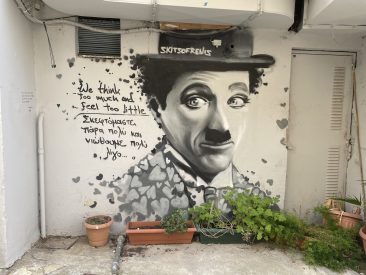
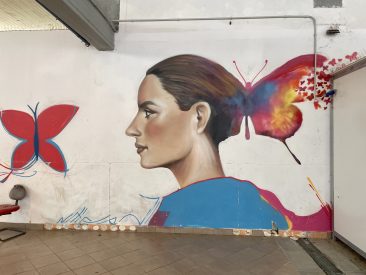
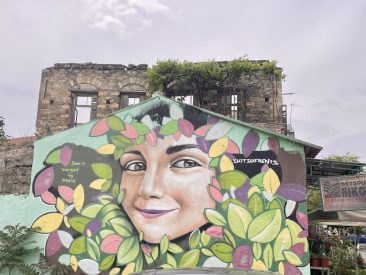
The next morning we have an appointment with Kostas Louzis, a local artist. Under the name Skitsofrenis, he has beautified the city in recent years with murals that are several meters high, such as the image of the four freedom fighters we admired yesterday. He has tens of thousands of followers on social media, and he is now known at home and abroad. His work can now also be found in countless places outside Kalamata and even outside Greece.
Over a coffee on the terrace of Bistroteca on the central Aristodimou, Kostas tells us his story. The artist was born in a small village in a family of olive farmers, just outside Kalamata. He started drawing very early, actually out of boredom, because there was no one to play with. He became obsessed with drawing, studied comic books and continued to improve his art work.
In 2008 he finished his studies and was released from military service. Someone asked him – via the local newspaper for which he often made caricatures – if he wanted to paint a wall on the road in the mountains above Kalamata. The Peloponnese had been seriously affected by forest fires the year before. The initiator wanted a mural along the road with a clear message for the residents: think more about the environment!
Kostas had never done this before, making real street art. But he commited himself to this difficult task. Every morning – for twenty days – he rode up the mountain and toiled on his work of art on the walls. And then – after a month – his first real graffiti work was finished.
Paradise and homeland
THat afternoon, we talk with Kostas for hours. He turns out to be much more than an artist. His works of art are often enriched with philosophical texts with a compelling socially critical message. And it turns out he really knows everything about this city, because history is another passion of this special man. His enthusiasm for the city of Kalamata shines through. “I wouldn’t leave here for anything” he admits. After the inspiring conversation, Kostas takes us on a walk past some of the works of art he has made in recent years. There is someone to greet him on every street corner.
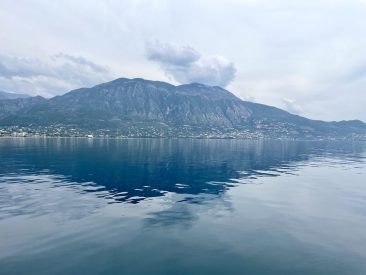
And then, after those truely inspiring hours, we say goodbye and walk from the old part of the city to the sea. You can walk straight to the beach in a straight line. Sitting on the boulevard, in one of the many beach bars, we look out at the now mirror-smooth sea and the steep slopes of the Taïgetos Mountains until well into the evening. Not much later we finally see the sun setting in the wide bay. “What some call paradise and others call homeland,” Paschalidis sings in his song. Probably for good reason.
Extra information
Museums
Kalamata has a surprising number of museums for a relatively small city:
–Archeological Museum of Messinia
–Kalamata War Museum
–Victoria Karelias Collection
-an open-air train and railway museum: Railway Park
-the Modern Greek Art museum
-the Folklore Museum Kalamata
Cycling
The city is very easy to explore by bicycle because it is quite flat. A cycle path has been constructed in the center that leads over a length of four kilometers from Othonos Square in the old center to the sea. You can also cycle along the sea boulevard, the Navarinou.
We rented a bike from Mike Vasileiadis, who runs The Basement, bike & street shop. The best bicycle man in town, according to the locals. Info: The Basement Bike Shop
International Dance Festival
Kalamata annually organizes a day-long Kalamata Dance Festival, which usually takes place in July. The location is the Megaron in the heart of the city center. Info: Kalamata International Dance Festival
Around Kalamata
The city is a perfect base for a varied trip and an exploration of the Peloponnese. You can visit the Mani, visit the caves of Diros, go into the Taïgetos Mountains, explore the Byzantine city of Mystras. There are also many beaches, some with sand, others with pebbles. We enjoyed Mikri Mantineia, a beach a fifteen minute drive outside the city. There are also great beaches to visit on the west side of Messinia, such as the beautiful Voidokilia Bay. The archaeological highlights such as ancient Olympia, the Theater of Epidaurus and Mycenae are all within driving distance, approximately one hundred kilometers.
This article previously appeared in the printed Griekenland Magazine in the Netherlands, Summer 2023.
Do you want to read more about the regio around Kalamata? Take a look at my blog: The Bay of Navarino